

How To Activate Window 8.1 Pro Build 9600
LEDEffects
Below an overview of this article.
All these furnishings work with NeoPixel and FastLED, and with each effect I made a piffling demo video.
UPDATE – All furnishings in one sketch
Bij popular need, I've written an article how all these effects tin be placed in ane sketch, allowing yous to toggle effects.
Read more than about information technology in this article: Arduino – All LED effects in 1 Sketch. (updated the link)
Overview
- oneLEDEffects
- 2Preparing your Arduino and your LED strip
- 3Helpful tool: Color Picker
- ivMake your effects cooler: Lengthened Light (toilet paper magic)
- 5Required Library - NeoPixel or FastLED ?
- Bones framework
- FastLED Framework
- NeoPixel Framework
- sixLEDStrip Result - Fade In and Fade Out: Red, Green and Blue
- 7LEDStrip Upshot - Fade In and Fade Out Your own Colour(s)
- 8LEDStrip Effect - Strobe
- ixLEDStrip Issue - Blinking Halloween Eyes
- 10LEDStrip Issue - Cylon
- 11LEDStrip Event - The new KITT
- 12LEDStrip Result - Twinkle
- thirteenLEDStrip Effect - Random Color Twinkle
- 14LEDStrip Upshot - Sparkle
- fifteenLEDStrip Effect - Snow Sparkle
- 16LEDStrip Event - Running Lights
- 17LEDStrip Effect - Color Wipe
- 18LEDStrip Effect - Rainbow Bike
- 19LEDStrip Effect - Theatre Hunt
- 20LEDStrip Issue - Theatre Chase Rainbow
- 21LEDStrip Upshot - Burn
- 22LEDStrip Consequence - Bouncing Balls
- 23LEDStrip Upshot - Multi Color Bouncing Balls
- 24LEDStrip Effect - Meteor Pelting
Ad Blocking Detected
Delight consider disabling your ad blocker for our website.
We rely on these ads to be able to run our website.
Y'all can of grade support us in other ways (encounter Support Usa on the left).
Preparing your Arduino and your LED strip
Please keep in mind that these effects are here for you to play with and hopefully invite you to create your own cool effects …
For your convenience, yous tin download all sources here as well:
Download - LEDEeffects Sources
| Filename: | LEDEeffects-Sources.nothing |
| Platform: | Undefined |
| Version: | 1.0 |
| File size: | 34.5 kB |
| Engagement: | 2015-11-08 |
| Download Now Send me a cup of Java | |
These examples rely on the following setup (equally described in the Decision-making a WS2812 LED with an Arduino article).
Please read carefully.
Arduino IDE and Library versions
For this commodity I have used the Arduino IDE one.6.half dozen, which (after you installed either FastLED or NeoPixel) will bear witness a message to update either of these (and peradventure others) libraries. Please do so.
Arduino Connected to PC
The following I utilise for when the Arduino is continued to my PC :
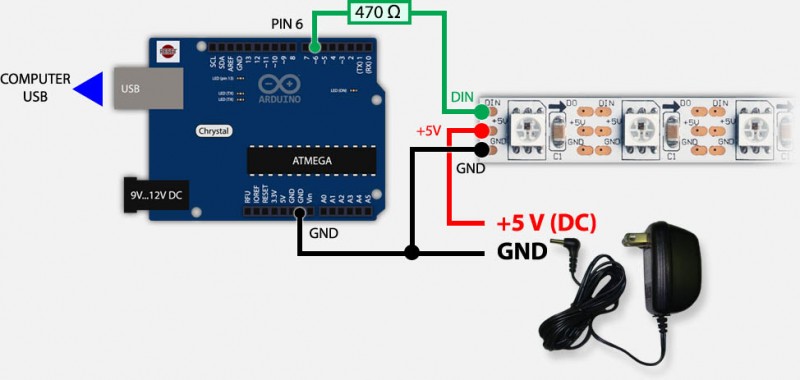
Arduino & WS2812 – USB and External Power
Arduino Standalone
After yous've uploaded your variation of effects into the Arduino, and you'd similar it to run standalone, then this setup is what you need. Without a connection to your calculator, the Arduino will need +5V from the external power supply.
This is for stand-alone ONLY so when the Arduino is Not connect to a PC!
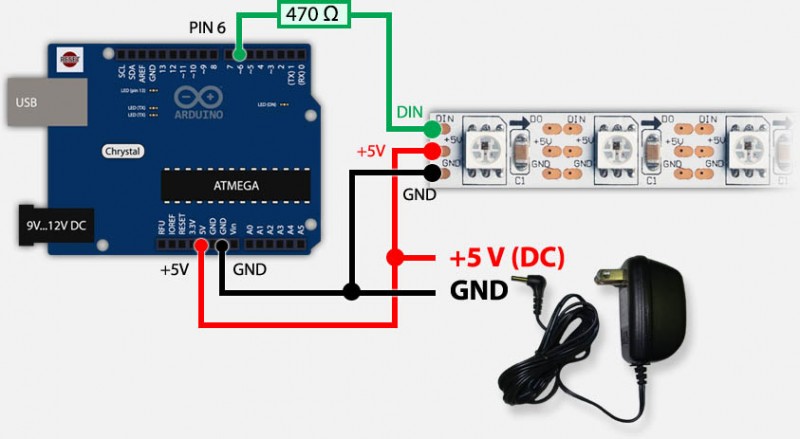
Arduino & WS2812 – Only running on external ability supply
This tool might be helpful when picking colors:
LED colors are build upwards out of 3 numbers:red, greenish and blue (RGB).
Each number is a byte so information technology each has a range of 256 values (Decimal: 0 … 255, Hexadecimal: 00 … FF).
Now the human brain (commonly) doesn't work with RGB numbers, then I've added this little tool to selection colors.
Y'all can select the color and information technology should requite you the hexadecimal value of the selected colour.
Please note that the LED colors might be slightly off – subsequently all they are not calibrated.
Color picker:
Usage:
Click the input box and a popup will show a colour picker. Cull your color, and the hexadecimal value will appear.
To use this in your Arduino Sketch:
The start 2 characters correspond RED ,
the 2d gear up of two characters is for GREEN and
the terminal two characters represent Bluish .
Add '0x' in front of each of these hex values when using them ('0x' designates a hexadecimal value).
Example:
Thisregal isB700 Fe.
The hexadecimal values: red is B7 , green is 00 and blue is FE .
As the Arduino can work straight away with hexadecimal number, you lot will need to type "0x" in front of it – so it tin see the difference between regular decimal number and these hexadecimal numbers.
So for example a NeoPixel strip.Color() call would look something like this:
strip.Color ( 0xB7 , 0x00 , 0xFE ) ;
Advert Blocking Detected
Please consider disabling your advertising blocker for our website.
We rely on these ads to be able to run our website.
You can of course support us in other ways (run into Support The states on the left).
Brand your effects cooler: Diffuse Low-cal (toilet paper magic)
I dear playing with these LED strips, but sometimes they experience a little too … I don't know how to say it.
With some effects y'all'd adopt to non see the individual LEDs light upwards.
To remedy that without too much endeavour, you can diffuse the light – brand it more fuzzy.
There are different techniques for that, anywhere from using ping-pong balls (which works great for i or 2 LEDs), frosted drinking glass (tube light!) or plastic tubes, cloth sheets etc.
I had none of these bachelor – I used to have ping ping balls but my dog decided information technology to exist awesome for chasing and chewing. So I'm out of those.
To my surprise, regular toilet paper (yeah!) really does a pretty practiced job with the diffusing as well. Naturally, I had only "fancy" toilet newspaper with a print on it, and neutral toilet paper would have looked even better, but you get the idea when you se these two examples.
Only make sure to keep the toilet paper roughly an inch (two to 3 centimeter) above the LEDs – don't let the LEDs touch the toilet newspaper.
Note: Both examples wait better when held vertical, but without much assist in my house, I had to practice it horizontally.
The Burn Effect is my favorite and shows best in a darker environment, but expect at what the toilet paper is doing … I love it!
The Red, White and Blue billowy balls expect a lot more interesting when diffused as well.
Required Library – NeoPixel or FastLED ?
Since both are pretty good, but are not used in the same way – ie. they are not driblet-in replacements for each other. That'southward why I decided to create a few "generic" functions then that the "effect" role here can exist generic also, then these functions work with either of these ii libraries.
Either library tin be used!
Beginning make sure either NeoPixel or FastLED is installed. To install i (or both) of these desired library, I refer you to the article "Arduino – Decision-making a WS2812 LED strand with NeoPixel or FastLED".
Annotation : FastLED seems slightly faster. In the tests I've run I would estimate that FastLED is almost 15% faster than NeoPixel. Y'all volition notice this with large amounts of LEDs (as I experienced with 300+ LEDs). On the other manus, NeoPixel seems to take less memory on your Arduino. Also note that the functions in FastLED are far superior to NeoPixel.
At present I wrote tiny wrappers around some of the bones functions of NeoPixel and FastLED – and I'k sure in that location is room for improvement. Suggestions are welcome.
Basic framework
For each of the LEDStrip effects, nosotros volition utilize a basic framework of code which nosotros reuse in each of the furnishings.
Information technology is important that you pay attention to these since the basic settings for your strip is being done there.
Now in this framework I've also defined 3 generic functions.
These functions will automatically grab the code needed for the library you're using (when compiling).
showStrip( );
This function merely applies the contempo changes to pixel colors and makes them visible.
It calls strip.show (NeoPixel) or FastLED.testify (FastLED).
setPixel(Pixel, red, green, blue);
With this function nosotros set the color of an individual pixel (LED).
You will need to laissez passer the pixel number (start counting at cypher) and the RGB values.
For NeoPixel it volition call setPixelColor, and for FastLED it will assign values to the leds array.
setAll( red, green, blueish);
This part sets the unabridged strip to a give color. You lot can use information technology to set the unabridged strip to a given color or for example with setAll(0,0,0) to blackness (off).
The code we present, with each of the furnishings, is uncomplicated replacing this office of the code in the framework code:
i
2
iii
4
5
6
7
// *** REPLACE FROM HERE ***
void loop( ) {
// ---> here we phone call the effect part <---
}// ---> hither we define the consequence function <---
// *** Supplant TO Here ***
And so in our effects code examples you will but see theloop() department and the outcome office.
Settings and the three wrapper functions will non be displayed, merely are most certainly needed!
FastLED Framework
This is the basic code for apply with theFastLED library.
Here we include the needed library (line ane), define the number of LEDs (line 2), define the Arduino pin used (line 4), and define some strip specific settings (line 8) like color lodge (RGB, GRB etc.).
ane
2
3
4
5
6
7
8
9
10
xi
12
13
14
15
16
17
18
19
20
21
22
23
24
25
26
27
28
29
30
31
32
33
34
35
36
37
38
39
40
41
42
43
44
45
46
47
48
#include "FastLED.h"
#define NUM_LEDS 60
CRGB leds[NUM_LEDS] ;
#define Pivot sixvoid setup( )
{
FastLED.addLeds <WS2811, PIN, GRB> (leds, NUM_LEDS).setCorrection ( TypicalLEDStrip ) ;
}// *** REPLACE FROM HERE ***
void loop( ) {
// ---> here we call the effect function <---
}
// ---> here nosotros ascertain the effect office <---
// *** REPLACE TO HERE ***
void showStrip( ) {
#ifdef ADAFRUIT_NEOPIXEL_H
// NeoPixel
strip.show ( ) ;
Subscribe to: Post Comments (Atom)
0 Response to "How To Activate Window 8.1 Pro Build 9600"
Post a Comment